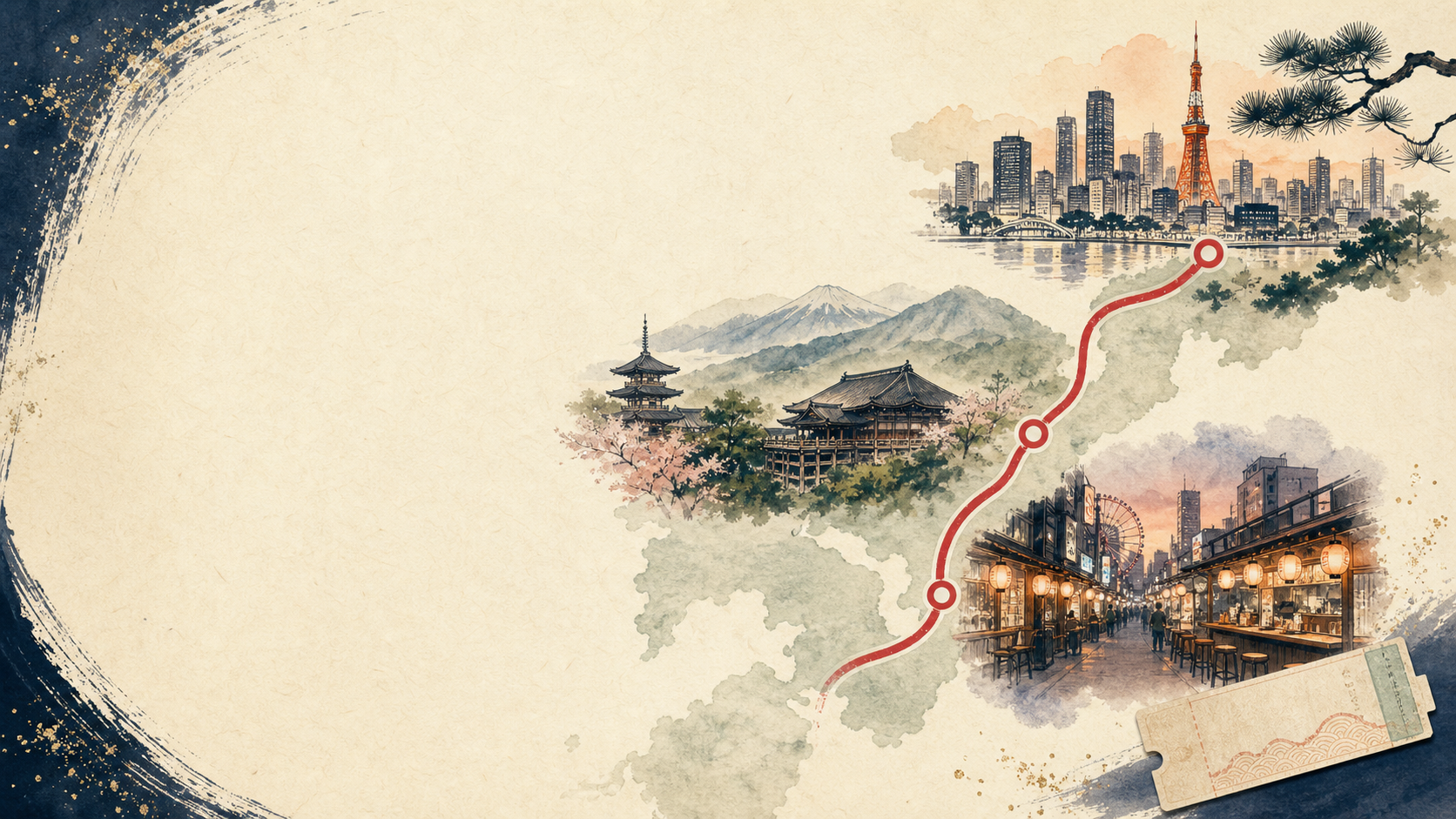
The short answer is make Tokyo and Kyoto the two real bases, then treat Osaka as a flexible day or a final overnight. Seven days can hold all three names on a map, but it cannot give each city the same depth. The route works when Tokyo and Kyoto get the time, and Osaka earns its place through food, atmosphere, or departure convenience.
The route in one sentence
Start with three nights in Tokyo, move once to three nights in Kyoto, and use Osaka as one day or one final night depending on your flight and energy. That keeps luggage moves low while still letting the trip change texture.
Why this shape works
Tokyo is not one city experience. A first visit needs room for at least two contrasting neighborhoods, one slower cultural stop, and one open slot for the thing you discover after arriving. Kyoto needs the same generosity in a different form: early mornings, temple or garden time, an evening district, and enough space not to turn every famous site into a timed sprint.
Osaka can be excellent, especially when food, night streets, or a more direct final-day route is the appeal. The mistake is giving it equal weight just because it is nearby. You can see its character in a day. You cannot see Tokyo, Kyoto, and Osaka deeply in two nights each.
A realistic seven-day shape
| Day | Useful focus | What to protect |
|---|---|---|
| 1 | Arrive in Tokyo and do only a local evening | Do not schedule a major ticket or cross-city route |
| 2 | Tokyo neighborhood day | Leave one unplanned meal or walk |
| 3 | Tokyo contrast day | Use a second area rather than revisiting the same itinerary style |
| 4 | Move to Kyoto | Keep the arrival evening simple |
| 5 | Kyoto early morning and one main area | Avoid stacking distant temples all day |
| 6 | Kyoto plus a possible Osaka evening | Make Osaka optional, not compulsory |
| 7 | Osaka or Kyoto departure day | Stay near the departure route the night before when timing is tight |
This is a shape, not a command. A late arrival may mean Tokyo gets only two full days. In that case, remove Osaka before you remove recovery time.
What to leave out
Do not add a fourth city because a train connection looks easy in isolation. Every extra base means packing, check-in, orientation, and a missed opportunity to revisit a place when the light or your appetite improves. Japan's official tourism network covers Tokyo, Kyoto, Osaka, and many other regions, which is exactly why the first route should be selective. The country will still be there for a second trip.
For a decision between the first two bases, start with Tokyo or Kyoto?. For the practical confidence question, use Japan without speaking Japanese before you book a route that assumes every transfer will feel effortless.
Final answer
For seven days, give Tokyo and Kyoto the center of gravity, then use Osaka as a flexible addition. The best first Japan itinerary feels like two places you had time to inhabit, not three hotel lobbies you passed through.
Sources & verification
Official references used to check the practical details in this guide. Schedules, prices, and access can change, so verify them again before travelling.