About Apollonia
Apollonia (*Apolonia* in Albanian) was founded as a Greek colonial city around 588 BCE by settlers from Corinth and Corfu. Over the following centuries it grew into one of the most significant cities on the Adriatic coast — a trading hub, a philosophical center, and eventually a prosperous Roman colony of sufficient standing that Augustus Caesar spent a formative period studying here before receiving news of Julius Caesar's assassination and returning to Rome to claim his inheritance.
Cicero called it *magnifica urbs et gravis* — "a great and illustrious city." It minted its own coinage and maintained a school of philosophy known across the ancient world.
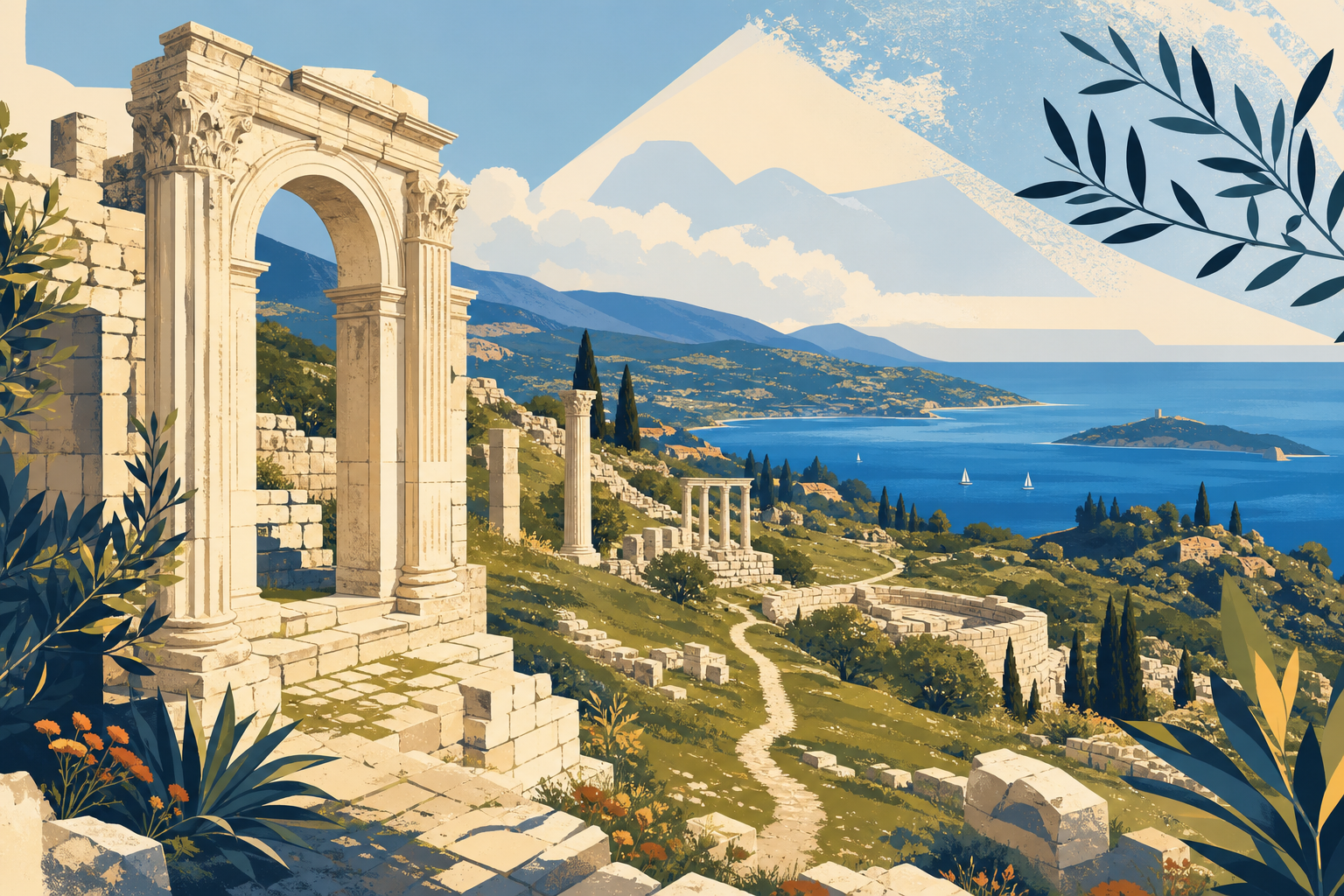
Today the site is partially excavated on a gentle hill near the town of Fier, about 140 km south of Tirana. The most impressive surviving monuments date to the Roman imperial period. The setting — rolling agricultural land, olive trees, and a monastery built into the ancient ruins — gives Apollonia an atmosphere of quiet pastoral grandeur that differs markedly from the more dramatic settings of Butrint or Berat.
What to See at Apollonia
The Bouleuterion (Council House)
The best-preserved structure at Apollonia. A Roman-era council chamber with a colonnaded facade, it stands almost complete — one of the better-preserved examples of this building type in the entire Adriatic region. The columns and entablature are largely intact.
The Odeon
A small covered theatre used for musical performances and smaller civic gatherings. Less complete than the Bouleuterion but still clearly legible in form.
The Stoa
A long colonnaded walkway fronting the agora (public square), partially reconstructed. The stoa gave citizens a shaded space for commerce and conversation.
The Monastery of St Mary of Apollonia
A Byzantine monastery built within the ancient ruins in the 13th century CE. The monastery church is still standing and well-preserved. It now houses the Apollonia Archaeological Museum — a collection of sculpture, coins, pottery, and inscriptions recovered from excavations at the site. The museum provides essential context for understanding the city's long history.
The Roman Triumphal Arch
A partially preserved arch dating to the Roman imperial period, visible near the monastery.
The City Walls and Gates
The substantial Hellenistic-era city walls are partially preserved around the site's perimeter. The original circuit enclosed a large area indicating Apollonia's significant population at its height.
Practical Information
Getting there:
- From Tirana: approximately 140 km south on the SH4 (A3). The Apollonia site is about 12 km west of Fier town, near the village of Pojani. Journey from Tirana approximately 1.5–2 hours by car.
- From Berat: approximately 35 km southwest. An easy combination — visit Apollonia on the way to or from Berat.
- By public transport: Buses run from Tirana to Fier. From Fier, local transport or a taxi to the Apollonia site (approximately 12 km). A taxi from Fier to the site and back (with waiting time) is a practical option.
At the site: The site is open-air and large; comfortable walking shoes are recommended. Bring sun protection as shade is limited. The monastery/museum provides good context — visit it before or after walking the ruins.
Time needed: 1.5–2 hours for the main site and museum.
Tips for Visiting
- Combine with Berat on a central Albania day trip — Apollonia (1 hour from Berat by car) and Berat make an excellent pairing for history enthusiasts
- Visit in spring when wildflowers bloom among the ruins
- The site is less visited than Butrint — you may well have sections to yourself even in high season
- The monastery church is worth a careful look for its Byzantine architectural details
Frequently Asked Questions
How do you get to Apollonia from Tirana? By car on the SH4/A3 south — approximately 1.5–2 hours. By public transport, take a bus to Fier and then a taxi to the site (approximately 12 km from Fier).
Is Apollonia a UNESCO site? Apollonia is not on the UNESCO World Heritage List, though it has been proposed for inclusion. It is a nationally protected archaeological zone in Albania.
How significant was Apollonia historically? Very significant. It was one of the most important Greek colonies on the Adriatic, later a major Roman city, and notably the place where the future Emperor Augustus studied before Julius Caesar's assassination.
What is the connection between Apollonia and Augustus? When Julius Caesar was assassinated in 44 BCE, his great-nephew Gaius Octavian was studying in Apollonia. He returned to Rome and, as Caesar's adopted heir, eventually became the first Roman Emperor Augustus. Apollonia was thus the location where one of history's most consequential careers was effectively launched.
How does Apollonia compare to Butrint? They are complementary rather than competing. Butrint is more dramatically sited and has earlier and later historical layers (Greek through Venetian). Apollonia is primarily Roman and Hellenistic, more pastoral in setting, and significantly less visited. History enthusiasts should see both.
Is Apollonia worth visiting? Yes, especially for visitors interested in ancient history, Greco-Roman archaeology, or a less-visited alternative to busier sites. The Bouleuterion is a genuinely impressive monument. The pastoral setting and relative solitude make it a pleasant and different kind of Albanian experience.