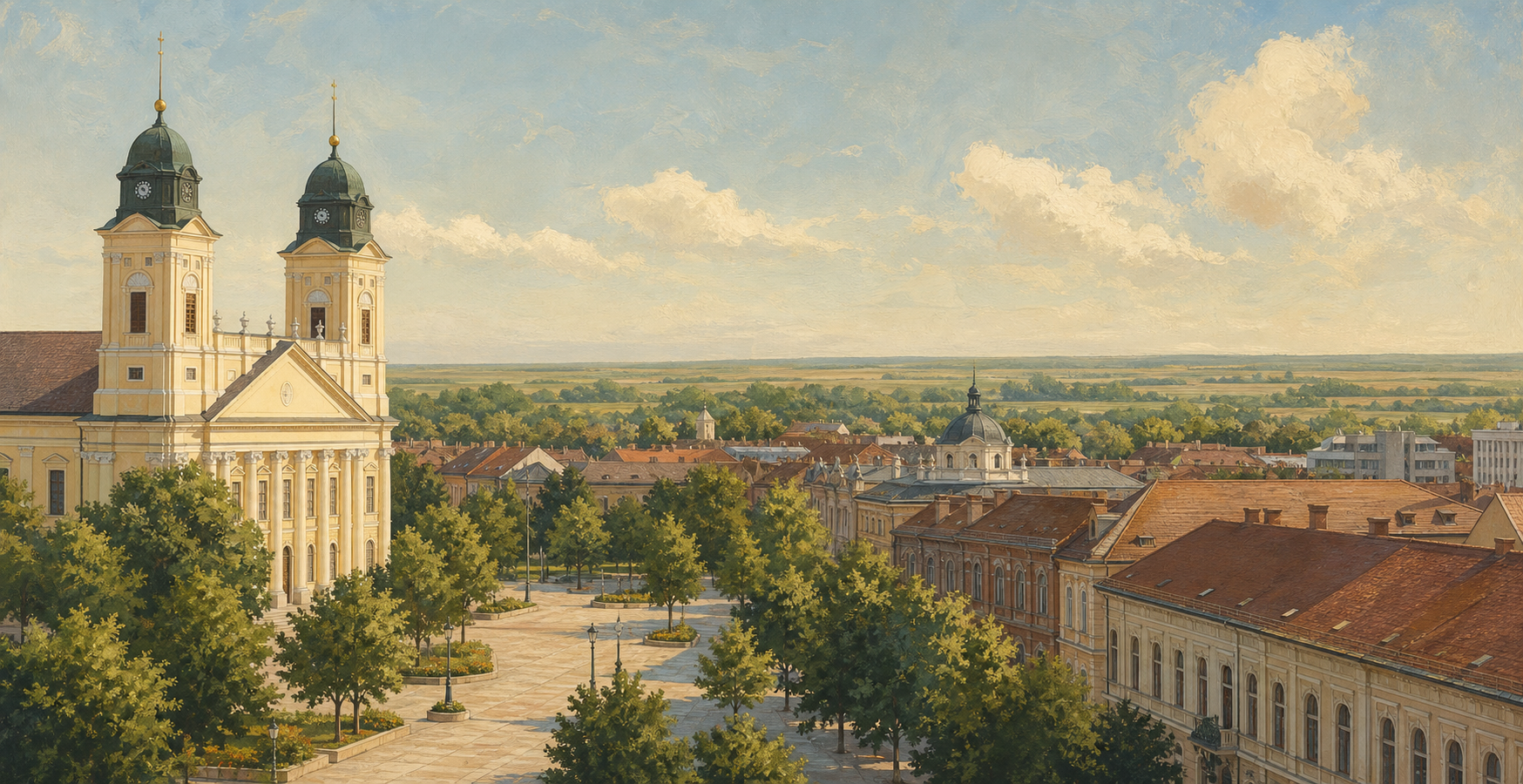
Why Visit Debrecen?
Debrecen (*population approximately 200,000*) is Hungary's second-largest city — but it occupies a different cultural space from Budapest. Where Budapest is imperial, Catholic, and Austro-Hungarian in character, Debrecen is Protestant, Hungarian-speaking, and deeply connected to the Great Plain that surrounds it. It was a center of Hungarian Reformed (Calvinist) Christianity for centuries, sheltering the Hungarian language and identity during the Ottoman occupation and Habsburg rule when much of the country was controlled by foreign powers.
In 1849, Lajos Kossuth proclaimed Hungarian independence from the Great Reformed Church during the revolution. The church is still standing, and this moment is still commemorated.
Debrecen is also a major university city — home to the University of Debrecen, one of Hungary's largest, which gives the city a young, culturally active character. And it is the primary gateway to Hortobágy National Park, 40 km to the west.
Top Things to Do in Debrecen
The Great Reformed Church (Nagytemplom)
The defining landmark of Debrecen — two neoclassical towers visible from across the flat Great Plain cityscape. Built 1814–1823, it seats approximately 5,000 worshippers and remains one of the largest Reformed (Calvinist) churches in Hungary. The interior is notable for its austerity — in sharp contrast to the Baroque Catholic churches of western Hungary, it is deliberately unadorned, following Reformed theology's rejection of religious imagery. The clock tower can be climbed for city views. Entry fee applies.
Kossuth Square (Kossuth tér)
The main square of Debrecen, dominated by the Great Reformed Church and flanked by the neoclassical City Hall. The square has been substantially redesigned in recent years with fountains and improved public space. A statue of Lajos Kossuth stands before the church. The square is the heart of city life.
The Calvinist College (Református Kollégium)
Adjacent to the church, the historic Calvinist College (founded 1538) is one of the oldest continuously operating educational institutions in Hungary. The college library contains important historical collections; a museum within the building covers the history of Hungarian Protestantism. The college was a center of Hungarian literacy and cultural preservation during the Ottoman and Habsburg periods.
Déri Museum
The city's main museum, containing a significant fine arts collection including Mihály Munkácsy's large-scale Passion Trilogy paintings (*Christ Before Pilate*, *Golgotha*, *Ecce Homo*). The Munkácsy paintings are among the most important 19th-century Hungarian paintings on display anywhere. The museum also has archaeological and ethnographic collections. Entry fee applies.
Debrecen Zoo and Amusement Park (Debreceni Állat- és Növénykert)
One of the better regional zoos in Hungary, adjacent to the Great Forest (*Nagyerdő*) — a large recreational woodland north of the city center. The Great Forest includes the city's thermal baths, a lake, and extensive parkland popular with locals.
The Flower Carnival (Virágkarnevál)
Every August (typically around 20 August, coinciding with St. Stephen's Day — Hungary's national day), Debrecen hosts the Flower Carnival — one of Hungary's largest annual festivals. A parade of elaborately decorated floats covered in fresh flowers moves through the city center, accompanied by performances and events. The city fills with visitors for the week; book accommodation well in advance.
Gateway to Hortobágy
Debrecen is the most convenient base for Hortobágy National Park — 40 km west by road or bus. The crane migration (October), horsemen shows, and the Nine-Arch Bridge are all accessible on a day trip from Debrecen. See the Hortobágy National Park guide for details.
Getting to Debrecen
By train from Budapest: InterCity (IC) trains from Budapest Keleti to Debrecen. Journey approximately 2–2.5 hours. Book IC supplement in advance.
By air: Debrecen International Airport has connections to several European cities, particularly with Ryanair. Check current routes.
By car: Approximately 230 km east of Budapest on M4/M35 motorways. Approximately 2.5 hours.
Where to Stay in Debrecen
Debrecen has a range of accommodation from budget guesthouses to mid-range hotels, concentrated around the center and near the university. The main square area gives the best access to attractions.
Search on Booking.com for current rates.
Frequently Asked Questions
Is Debrecen worth visiting? Yes, particularly as part of an eastern Hungary itinerary combining it with Hortobágy. As a standalone destination, it is interesting but requires an interest in Hungarian Protestant history or the Flower Carnival.
What is Debrecen famous for? The Great Reformed Church, the 1849 declaration of Hungarian independence, the Flower Carnival (August), and as the gateway to Hortobágy National Park.
How far is Debrecen from Budapest? Approximately 230 km east; approximately 2–2.5 hours by IC train or 2.5 hours by car.
Can I visit Hortobágy as a day trip from Debrecen? Yes — Hortobágy village is approximately 40 km west and easily reached by bus or car. A half-day covers the main sights; a full day is needed for serious birdwatching.